My favorite hiking notebook is the Rite in the Rain 371FX-M. It weighs 20 grams, fits in my shirt pocket, and works fine when soaked with rain (or sweat).
Here are a couple of them that have been on a few treks.
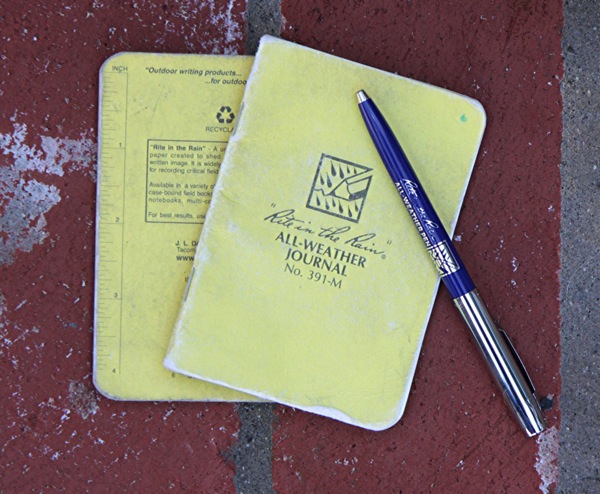

My favorite hiking notebook is the Rite in the Rain 371FX-M. It weighs 20 grams, fits in my shirt pocket, and works fine when soaked with rain (or sweat).
Here are a couple of them that have been on a few treks.
Pop over to the Gossamer Gear blog to read my article about the load that Scoutmasters carry. The real load is responsibility, but you can respond to it with gear or with training. One of them weighs less on the scale.

Gear without skills is dead weight. In 2010, The Mountaineers revised the Ten Essentials for a list of items to a list of functional systems. What skills are needed to actually use these essentials?
The New Ten Essentials—A Systems Approach was published in Mountaineering: The Freedom of the Hills, 8th Edition. The list was first formulated in the 1930’s as a tool to increase safety for climbers on Mount Rainier.
Every December, I break out the Speedball italic nib and the Dr. Ph. Martin’s Bombay Red india ink. I tried a few too many inks until I found one that was Christmas red and sufficiently opaque.
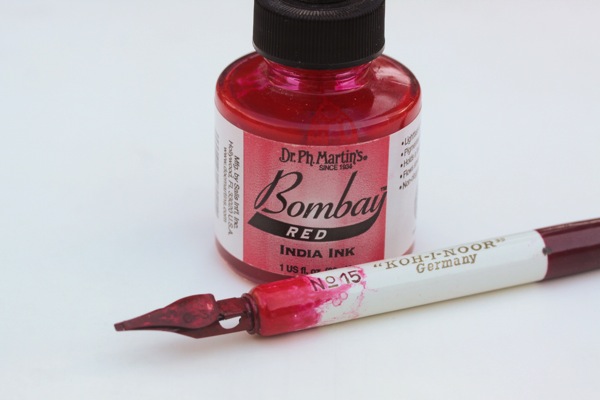
My lettering isn’t great, but people give a fair amount of slack for hand-lettered gift tags.
This looks like a great kit for Electronics merit badge. If I count correctly, it has 26 through-hole solder joints. Half the components are resistors, which work even if you put them in backwards.
The result is an LED-powered flame-like flickering light. I am pretty sure this is a “control device circuit”, as described in requirement 4a.

The kit is around $6, depending on how many you order. Check out the Evil Mad Scientist Flickery Flame Soldering Kit.
There is also a Solderless Flickery Flame Kit for around $9. But where is the fun in that?
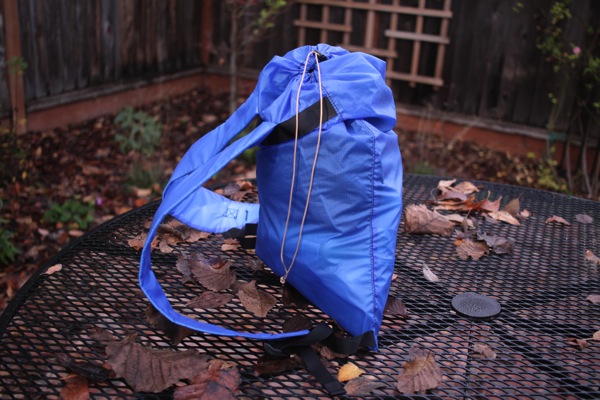
A daypack is pretty useful on a Philmont trek, but only if it is really light. The Gossamer Gear Riksak is 2.9 ounces and doubles as a stuff sack. It is made of silnylon and costs $30.
I expected to learn first aid in the Wilderness First Aid course, but I did not expect to learn so much about planning and teamwork.
I first took Wilderness First Aid (WFA) in 2009 and I’ve taken the course again three times since then to recertify. The material hasn’t changed much, but I always learn or re-learn something.
Our WFA class uses a lot of practical scenarios. All of them require teamwork, and they are planned to stretch your skills. That means that you kill the patient most of the time. We learn a lot more from failure than from success.
OK, so I broke our Vegan September by adding (excellent, imported) Parmesan, but this was a tasty backpacking meal and still vegetarian. I’d use fresh mushrooms and spices for guests at home, but this is a tasty, filling meal on the trail.
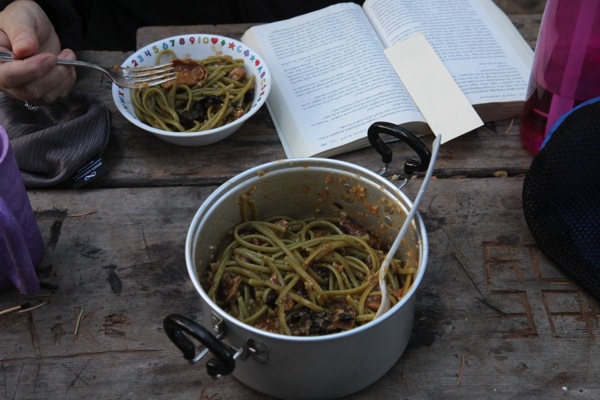
This recipe is from Teresa Marrone’s The Backcountry Kitchen.
I feel more relaxed at the trailhead when I pack in a methodical fashion. I use our bed. The pack goes at the head, empty, and everything that will go into it is laid out in front of it.

This gives me an overview of what I’m taking and lets me run through the whole checklist.
This looks really interesting as a patrol-sized wood-fueled backpacking stove. I have the smallest model, which is great for one or two people. This is sized for more people and should work great for a Boy Scout patrol (around eight).
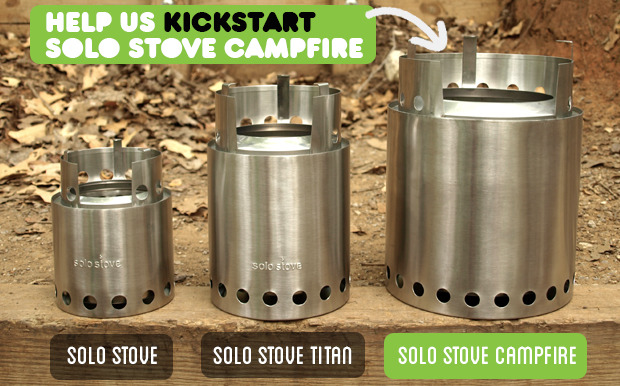
The design is about 7″ in diameter and about 9″ tall. That is roughly the size of a squared-off gallon milk jug, if you make a cylinder around the outside edges. It weighs two pounds, which is substantial, but not bad for a stove to feed a patrol. Remember, no fuel weight, only firestarter material.
Tina and I are going vegan for September, and we have a backpacking outing planned for the last weekend of the month. Teresa Marrone’s The Back-Country Kitchen is, once again, looking like the best resource.
Breakfast and lunch are not a challenge. I often have a Lärabar for breakfast at home. Oatmeal, bars, dried apricots (only Blenheims), figs, cashews, whatever, will get us through until dinner. But dinner is a challenge.
In the summer of 1971, my dad and I headed out on our first wilderness backpacking trip in the Pecos Wilderness. The first person we met on the trail was from our home town, Baton Rouge! Of course, we asked him how far it was to our destination, Beatty’s Cabin. He told us, but he added a bit of wisdom. When he went backpacking in the wilderness, he didn’t worry too much about specific spots. His destination was the wilderness, and he was already there. I still remember that—as soon as I leave the trailhead, I’m already there.
This photo is from our first stop on the trail that year, well before we met him. And yes, it was at Noisy Brook Creek, an odd name.
Feel the need for more trail selfies? Instead of a heavy tripod, support your iPhone for 38g (1.3 ounces) or your small camera for 30g (1 ounce). This kit goes on top of regular bottles like the 1 liter sparkling water bottle that is always in my pack.

There are two basic parts: a water bottle camera mount and a tripod adaptor for an iPhone (or other phone). If you have a lightweight camera, you can skip the phone mount and save 8 grams.
I’m seeing more and more backcountry books that suggest using hand sanitizer by itself. That does not work. Soap and water is necessary, sanitizer is optional.
The Scouts Backpacking Cookbook is one of those with that bad advice. The BSA Handbook gets it right. Wash your hands with soap and water.
Clean hands are important in the backcountry. People who know, like Tod Schimelpfenig, Curriculum Director at the Wilderness Medicine Institute of the National Outdoor Leadership School, believe that dirty hands are a bigger health risk than dirty water.
If you want to get started on trail cooking, turn to page 318 of The Boy Scout Handbook (14th edition, page 336 in the 13th edition). Choose one ingredient from each column, scale the amounts, and you are on your way.
Since the 11th edition Scout handbook in 1998, the cooking chapter has included a great “choose your own stew” recipe. It might have been in the 10th edition, but I don’t have one of those handy.
The 11th and 12th edition have slightly different lists, so I’ve combined both to make one table. I’ve also split vegetables out into their own column, since they are not really the same thing as cheese or nuts.
 Most Casual Observer