BSA neckerchiefs are finally big enough

Our troop is considering a new source and maybe a new design for neckerchiefs, so I checked out the price for official BSA neckerchiefs and got a big surprise. The BSA has made them a lot bigger. They say:

Design reverts back to the standard larger size offering a variety of uses, as a sling, signal, bandage, belt, patrol ID, and more. Standard size is now 49.5 inch X 35 inch X 35 inch.

The previous size wasn’t documented anywhere I could find, but I measured mine as 41 X 29 X 29 for my post with a table of sizes for different Scout neckerchiefs. I’ve updated that table with the 2011 BSA neckerchief.

Continue reading

How big is a Scout neckerchief?

Note: Updated Jan 2011 with the new larger BSA neckerchief size. Updated again Sep 2018 with new URLs and the 2015 edition of the ANSI standard.

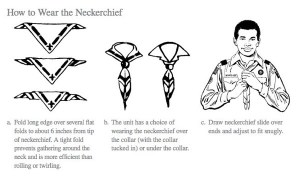
The BSA’s Insignia Guide says this about the size and shape of the neckerchief, “Official neckerchiefs are triangular in shape.” There is a more info about how to wear it, who chooses the neckerchief (the troop), who approves special neckerchiefs (the council), and so on. It does say that special neckerchiefs are “the same size as official ones”. Oddly, they don’t say what size that is.

How to wear neckerchief

So I researched it. One reason to have a bigger neckerchief is so it can be used as a triangular bandage, so I also checked the common sizes for those, including the ANSI-standard size.

Continue reading

Pyramid Tents at Philmont

I brought my Mountain Laurel Designs Speedmid to Philmont and my son brought his brand-new Black Diamond Betamid. The Betamid is interesting because it is decently light and probably the least expensive high-quality shelter you can find. A Scout is Thrifty.

We didn’t get a lot of rain, but we did get one good nighttime thunderstorm. Everybody stayed nice and dry.

Here is Mike (on the right) and his Betamid at Apache Springs:

_MG_1149

Continue reading

Tarp Camping in the Sierras

Summer in the Sierras is probably the best place to try tarp camping, since you would do fine with no cover at all most nights in our dry California summers. Still, there was hail the week before we were up, so it is worth getting your shelter dialed in. Here are some moments from our eight day trip through the Hoover and Emigrant Wilderness Areas.

Continue reading

My Gear List for the Emigrant and Hoover Wilderness Trek

Prodded by Scoutmaster Jerry’s post “So what’s in my backpack?”, here is what I carried on our eight-day trek in the Hoover and Emigrant. My base weight (not counting food and water) is on the lightweight side at under 25 pounds, but with at least five pounds of gear that other people might not bring, mostly the camera and Crazy Creek chair.

I’ll list the gear by category in decreasing order of weight, but first, a photo of everything that went into my pack laid out on my groundsheet, taken on day 7 of the trek.

_MG_5215

Continue reading

Fighting a Wildfire with Milk Jug Basins

On our Boy Scout trek in the Hoover and Emigrant Wilderness Areas, about half the crew brought basins made from the bottom of a plastic milk jug. Cut it just below the handle, and you have a free, ultralight basin.

The original idea was to use it to keep the freezer bag meals from falling over while they were rehydrating, but we kept finding new uses.

The least-expected use was for a bucket brigade to fight a single-tree wildfire that we found. The initial containment and a satphone report were done by Troop 959 from San Diego, but they needed to move on to evac an ill crewmember. Our crew (Troop 14, Palo Alto) took over and spent most of an hour putting it all the way out.

Continue reading

Mission Peak from Sunol

The other times that I’ve climbed Mission Peak with the Boy Scouts, we’ve started from Ohlone College. That is a 3.5 mile, steep, shadeless, climb on dusty roads through cow pastures. This time, I took the advice of a nice person at the East Bay Regional Park District and we started from Sunol. Still mostly on roads, but lots more shade, the climb is spread out very evenly over 5.5 miles, and the views are of Mt. Diablo instead of cows.

Even better, we overnighted at the Eagle Springs trail camp. Here is the view north across the campsite:

_MG_3987

Continue reading

You Know You Might Be A Scoutmaster If …

I’m scoring well below 50% on this test, but I do have several hits. Here they are:

  • You hoard tent stakes.
  • You cannot walk by a piece of trash without picking it up. (ever since I was a Scout …)
  • You carry a duffle bag size first-aid kit in your car. (meatloaf size, really)
  • You know all the words to “Little Bunny Foo-Foo”, but can’t remember where you left your briefcase. (I know where my briefcase is, but I misplace plenty of stuff)
  • You always cook enough food for twelve. (but this comes from growing up around Cajuns; if you are cooking something good, why wouldn’t you invite all your friends? Adults don’t cook for Scouts anyway, so this is a bogus one.)
  • You open letters with a pocket knife. (only when the sterling letter opener isn’t handy; I was raised in the south)
  • You know 365 one pot meals. (maybe only 30 or so)
  • You really do use those emergency sewing kits. (but they never have buttonhole twist, and sewing buttons back on is #1)

On a more serious note, I finally found the job description for Scoutmaster. It isn’t in the BSA Scoutmaster Handbook (a real Dilbert Moment); it’s in the Troop Committee training materials. It isn’t even in The Scoutmaster’s Other Handbook. For the uninitiated, the Troop Committee hires the Scoutmaster. The Dilbertness is for the hiring manager to know the job description and never tell the new hire. Geez. Hello Bob Mazzuca, put this on page one of the Scoutmaster Handbook.

So, here is the job description. I’ve tweaked it for our troop, changing Patrol Leaders Council (PLC) to “Greenbar” and adding notes about Scoutmaster conferences.

Scoutmaster (excerpted from BSA Troop Committee Guidebook, 1990):

  • Train and guide boy leaders
  • Work with other responsible adults to bring Scouting to boys
  • Use the methods of Scouting to achieve the aims of Scouting
  • Meet regularly with Greenbar for training and coordination in planning troop activities
  • Attend all troop meetings or, when necessary, arrange for a qualified adult substitute
  • Attend all troop committee meetings
  • Conduct periodic parents’ sessions to share the program and encourage parent participation and cooperation
  • Take part in annual membership inventory and uniform inspection, charter review meeting, and charter presentation
  • Conduct Scoutmaster conferences for all rank advancements (in T-14, for Scout, First Class, and Eagle ranks, others are by patrol liaison ASMs)
  • Provide a systematic recruiting plan for new members and see that they are promptly registered
  • Delegate responsibility to other adults and groups (assistants, troop committee) so that they have a real part in troop operations
  • Supervise troop elections for the Order of the Arrow
  • Make it possible for each Scout to experience at least 10 days and nights of camping each year
  • Participate in council and district events
  • Build a strong program by using proven methods presented in Scouting literature
  • Conduct all activities under qualified leadership, safe conditions, and the policies of the chartered organization and the BSA

Kinda big for a volunteer, spare time position, eh? The only saving bit is that you are required to delegate.

Hiking Mission Peak

Eight Scouts and six adults had a great time hiking up Mission Peak on Saturday a couple of weeks ago. The weather was great, sunny but not hot, with clear views of our next peak to climb in the Rim of the Bay series, Mt. Diablo.

One of our Assistant Senior Patrol Leaders was our leader and a new Scout, on his first outing with the troop, was our navigator, checking the map at each junction. Two Scouts on this trip had hiked Mission Peak two years ago as their first outing with the troop. A tradition!

We started up the trail at 9:18. The first section of the trail is almost as steep as the final climb to the peak, so we took two rest stops in the first hour. By 10:30, we were over that hump and stopped in the trees to snack and pull off our boots. No blisters! Out of the trees, we climbed up to a ridge with great views across the bay and a view of the peak ahead of us.

_MG_0615

After another rest stop and a tough hike up the last stretch, we reached the peak at exactly noon. We sat down, put on our windbreakers, and had lunch. The ASPL and I had a Scoutmaster Conference for his Eagle Palm. It set a personal record for the nicest location for a conference. We posed for a group photo, of course. I’m the one on the far right. If I look like I barely made it into the frame, it’s because I had ten seconds to get from behind the camera to on top of the rocks.

_MG_0641

The view was wonderful, from San Francisco down to San Jose, on the other side up to Mt. Diablo, and out to the Central Valley. We could see Del Valle Reservoir and the Ohlone Wilderness, where the troop will be taking a 20 mile backpack trip in the spring. To the south, the range of peaks continues, starting with Mt. Allison, which has a very impressive set of radio towers.

After a half hour lunch break on the peak, we chose to come down the other side of Mission Peak and discovered that the trail is much easier on that side. We circled back around the peak past the Eagle Spring trail camp, four sites with a wonderful view out to Mt. Diablo.

_MG_0657

As we came down off the ridge, the hang gliding club started launching, so we could see them playing along the ridgeline. As we were almost back to the Ohlone College trailhead, we could see a grass fire burning close by in Fremont.

_MG_0681

We got back to the trailhead at 3:10, just under six hours on the trail.

The hike leadership and navigation was great. It was clear that I was comfortable with the navigation, because I gave away both of my maps to two different people who asked me for directions. I was a bit sore for a few days, mostly because I’m still recovering from a bad ankle sprain, but it was a great hike and I’d do it again.

Uniform Inspections

Our Boy Scout troop has a boy-run uniform inspection at every meeting. Anyone who isn’t wearing a uniform shirt and troop neckerchief does five pushups. It isn’t hazing (forbidden by the BSA and a felony in Texas), since it applies to everyone and new Scouts get a pass for a while. Once last spring, 100% of the troop was in uniform, so the Senior Patrol Leader and his assistants did pushups. Seemed fair to me.

One Sign of a Boy-Led Troop

Last night we brought the newsletter home from the troop meeting. My son sat down to read it and skipped right past the Scoutmaster Minute (my column) to read the SPL’s column. That’s exactly right, the SPL leads the troop. In fact, my column was about adults supporting the PLC’s decision to have more day outings.

The SPL column also gave a quick overview of troop leadership. I like this part:

I, the Senior Patrol Leader (SPL), actually run the troop, not the adults; they just make sure we don’t make any bad decisions.

That is on the money, except that I’m OK with a certain level of bad decisions. That’s how you learn. I only step in to head off terrible decisions and I haven’t seen any of those yet.

One Hundred Years

This morning was the centenary of Scouting celebrated by Scouts gathered at 8 AM local time around the world. The time and date chosen for the birth of Scouting wasn’t when some paper was signed, it was the first morning at the first camping trip. Baden-Powell wanted to do something less military for boys than the boy’s brigades and cadet corps springing up around England — he thought drill wasn’t particularly useful even in the army — so he ran an experiment at Brownsea Island. Two patrols of boys and a few adults off in the woods for a week. Give it a go. Well, it worked.

We started by blowing a kudu horn, as B-P did to start the day at Brownsea. Scouting is an odd mix of the fun parts of the military (comrades, running around in the woods, shooting) and British colonial accretions (the kudu horn, broad-brimmed hats, shorts and knee socks). Scouting in the US adds another layer of confused traditions like emergency service as a sort of a junior volunteer fire department and selling war bonds mixed with Earnest Thompson Seaton’s skills-not-ranks system based on his Native American studies. It is a glorious melting pot of tradition with a special relationship with England and I can see why it doesn’t immediately appeal to non-Anglo Americans. In the rest of the world, Scouting is a very big tent, with many local traditions and religions. But that is a different article.

We had six Scouts and a few adults here in Palo Alto and five of our Scouts are at the World Jamboree along with one of our leaders. Nearly a third of the troop was out for the centenary, either here or in the UK. It was a great moment of community with Scouts and Guides around the world. We welcomed the Palo Alto morning with an African horn and recited our promise of duty to God, country, others, and ourselves. And the Scouts got to try blowing the kudu horn after the ceremony. The one who plays the trumpet was way better than our designated adult.

Oljato Stories: Attacked in the Tent

A true story from Troop 14 at Camp Oljato in summer 2007.

As the Scouts were getting ready for bed, I heard a yell from inside one of the tents, followed by some scuffling and “Mr. Underwood, I think we have a problem!” I asked what sort of problem, but just heard more muffled thumps, then things quieted down. “Did you take care of it?” “It was a nickel.”

As I reconstructed it, the Scout slid into his sleeping bag and his bare foot touched a cold nickel. I’m not sure what he thought it was, but it scared him. He jumped out and stomped the nickel until it wasn’t dangerous.

I’m just glad it wasn’t a quarter.

A Buddy, The Eleventh Essential

Scoutmaster Minute for Troop 14, March 27, 2007

You’ve probably heard about the Scout who was lost in the woods in North Carolina recently. He did a pretty good job of taking care of himself, getting water, keeping warm, but he could have done better. What are some of the things you can think of?

[Scouts answered with “stay in camp”, “don’t split up the troop leaving one adult and one Scout in camp”, “take food”.]

Those are good ideas. He did have some Pringles, which helped — those have a lot of calories.

Here is one thing that would have helped [pull a whistle out of my pocket], a whistle, one of the Ten Essentials1. A whistle makes you much easier to find. That would have helped the 200 people who spent four days looking for him.

There is another essential thing, and that is a buddy. We all learn the buddy system for Tenderfoot, because it is so important. He should have had a buddy when he left camp. When you have a buddy, you can make better decisions.

But the buddy system failed at an earlier point. He left camp to go home because his friends weren’t on the trip. He needed a buddy before he left the parking lot. He needed a buddy at the beginning of the trip.

So make sure that you have a buddy. Invite one on every trip. A buddy is the eleventh essential.2


  1. Yes, I know that the BSA calls them the “Outdoor Essentials”. I usually do, too, but that would spoil the punch line.
  2. The previous Scoutmaster Minute I posted was also about buddies, but there have been other topics, including an excellent one on focus by one of our ASMs. On the other hand, we’re working on increasing attendance on outings, so I may continue to touch on buddies, friends, and word-of-mouth.