Want to try a single-wall ultralight tent without spending a lot? How about the Mountainsmith Mountain Shelter LT, a two-person shelter that weighs less than two pounds for $100?


Want to try a single-wall ultralight tent without spending a lot? How about the Mountainsmith Mountain Shelter LT, a two-person shelter that weighs less than two pounds for $100?
A Nite Ize Gear Tie seems to do a decent job of supporting the MFJ-1820T 20 m whip antenna on my Elecraft KX3. I first tried forming it into a bipod, but then got the idea of attaching it to the SideKX endplates. Success!
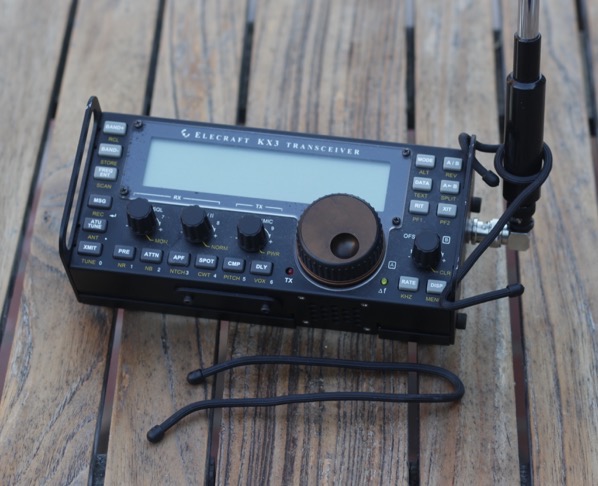
I’m using a Nite Ize Gear Tie 12 inch because I had one. The fatter one didn’t really fit through the handles.
The whole setup is pretty cheap. $25 for the antenna and $6 for two gear ties. It isn’t as efficient as a 20 m dipole, but it is kind of cute.
Did you know they made electrical tape in white? It takes Sharpie like a boss and sticks to everything. So get a roll and start marking your stuff.
Get the best tape because it is only $6 and will last a long time. I use Scotch Vinyl Electrical Tape 35.
I wanted a bit more “oomph” from my 1W 1.2 GHz HT, so I purchased a PC board Yagi to get another 6 dB.
I have a Yaesu FT-911 1.2 GHz HT. It is a 1990’s rig gifted me by the wife of a Silent Key at my work. It is a sweet handheld, but with limited power.
WA5VJB makes a variety of PC board antennas. The 1.2 GHz 3-element Yagi is $6, which was hard to resist. He also makes other nice microwave antennas: log-periodics, patch arrays, wheels, vivaldis, etc.
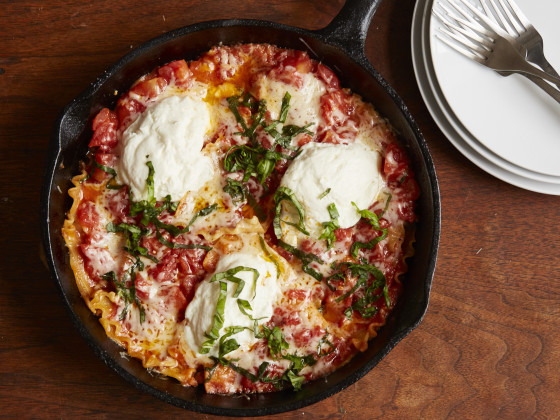
Made this tonight and it was tasty. This is a simple one pot meal, just right for Cooking Merit Badge. Scouts will learn to dice an onion (not required for the merit badge, but an essential skill), sauté the onion (also not required and also essential), and brown meat (which is always tasty).
They should also learn a bit of “mise en place”, getting everything ready and in its place before starting. The recipe doesn’t make that clear, but a mentor (Merit Badge Counselor) should walk them through prepping the tomatoes and onion first, then getting the other ingredients ready while those are cooking.
A few weeks ago, I noticed fresh peas in the pod at our grocery store. I was about to buy some, but I wasn’t sure how much to buy. I’d always used frozen peas. Well, the conversion factor is roughly a pound of peas in the pod to a cup of shelled peas. This batch was generous, with two or more cups from 1.25 pounds.
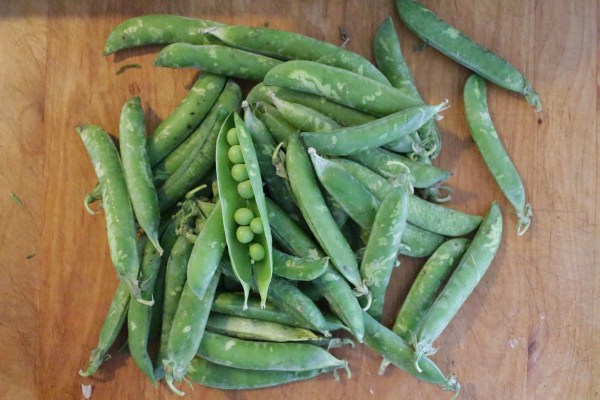
Fresh peas are great, so “double the peas” is like doubling the bacon or the chocolate. Not a problem.
I used fresh peas in the pasta last night, and I’ll keep using them as long as they are available.
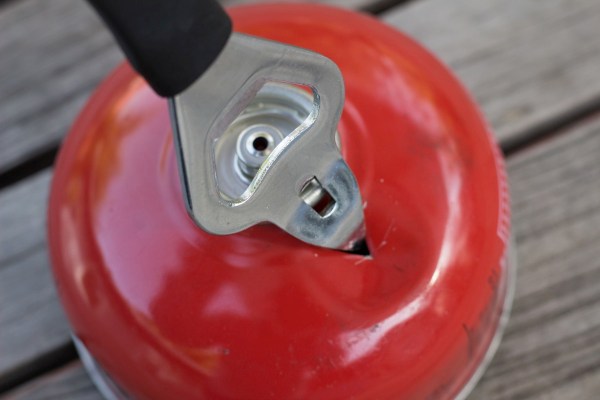
Worried about recycling the fuel canisters for your backpacking stove? Just poke holes in it with an old-style can opener, let the gas out, then recycle it. Done.
A kitchen splatter guard is just the right size for a backpacking stove windscreen. It costs $7 and weighs eleven ounces. A little heavy but a good choice for Boy Scout patrols.
It is tall enough to shield the flame of a canister-topper stove and big enough to leave room around the fuel tank so it won’t overheat.

Want speakers for your rig? No need to wait. For about the cost of a tank of gas, you could be sitting back and enjoying armchair copy.
The internal speaker in my KX3 is good but not great, plus the rig has stereo effects which you can’t hear through the single speaker. The headphone jack provides 100 mW per channel, which is not enough to drive speakers to a reasonable listening level.
This is my under $35 setup for an external audio amp and stereo speakers. Of course it would work for any other rig.
There are ten summits inside Philmont Scout Ranch that are listed in the Summits on the Air (SOTA) amateur radio program. There are another three summits within the Valle Vidal region to the north of the ranch. Only six of these thirteen peaks have been activated by SOTA operators.
SOTA is an award scheme for radio amateurs that encourages portable operation in mountainous areas. I think it is a great match for Scouting, combining the outdoors, technology, and world fellowship. Grab a radio, hike to the top of a mountain, and talk to people.
I’ve made this on a few backpacking trips and it has always been delicious. It is several cuts above the normal dehydrated meal. It is simple to assemble at home and needs only a few dehydrated vegetables. On an overnight, it is worth carrying some fresh sourdough bread to accompany the chili.
This is from my favorite outdoor cookbook, The Back-Country Kitchen: Cooking for Canoeists, Anglers, and Hikers by Teresa Marrone, page 125. I’m reprinting it here with her kind permission.
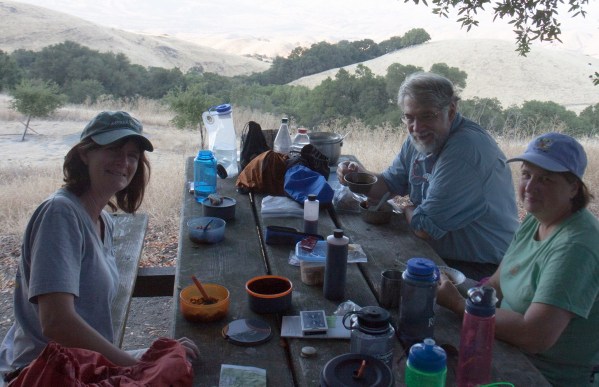
Here we are, enjoying the chili with friends at Eagle Spring trail camp, near Mission Peak.
I read 75 books in 2016. I started 78 books, but gave up on three of them. I signed up in the Goodreads challenge to read 75 books, because I thought I read roughly a book and a half each week. Well, I needed to read a lot of short books to hit that goal.
These are the best books I read last year.
Since 2011, Onno (VK6FLAB) has been producing weekly podcasts for beginning Australian amateur radio operators. The podcasts are short, from one to three minutes long. I’m no longer a beginner, but I really enjoy the podcasts. They are full of curiosity, advice, and encouragement. They make me want to get on the air.
The first series of podcasts, What use is an F-call? ran from 2011 through June 2015. These were about operating with with the Australian Foundation Licence, the entry-level license there.
The second series, Foundations of Amateur Radio, is still for Foundation Licence holders, but has a name that makes a bit more sense to non-Australian hams.
Each podcast has a text transcription, which helps with handicapped accessibility. Those are available on the website and I can see them in my iOS Podcasts app.
Loken has a dog collar for the Christmas season, for other seasons, and his regulation CCI blue collar. I used to break nails on the split rings while moving the tags until I realized I could use a locking S-biner to attach them.
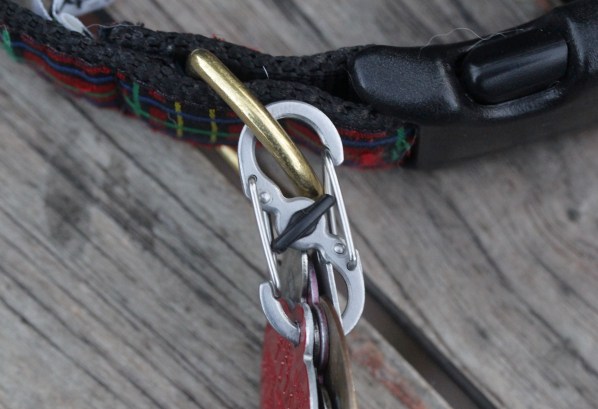
Put all the dog tags on one loop of the S-biner, then connect the other side to the collar. The lock bar is turned to prevent the S-biner from accidentally falling off.
To switch to another collar, turn the bar to unlock, remove the S-biner, and attach to the new collar.
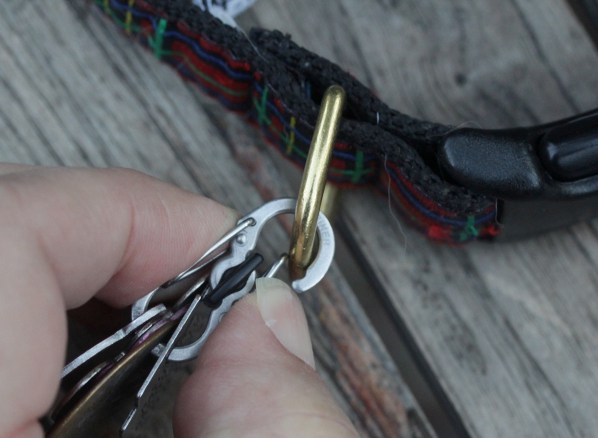
Locking S-biners are two for five dollars. I expect you can find a use for the second one. I got my locking S-biners at REI.
I first read this as an essay in the New Yorker in 1980, then read the book. I’m not at all sure that I have absorbed the wisdom. From the first page: “The most powerful men were those who most effectively used the power of adult competence to enforce childish agreements.”
That is a really creepy observation from 37 years ago when applied to Donald Trump in 2017.
The New Yorker has the first page of the original essay on their website. Check it out: “Within the Context of No Context“.
 Most Casual Observer