ARRL and BSA, Finally Together

The American Radio Relay League (ARRL) and Boy Scouts of America (BSA) published a memorandum of understanding where the ARRL will help with some merit badge requirements and get access to more young people for a dangerously-aging amateur radio population.

Let’s hope this project is more forward-looking than the new ARRL electronic kits which debuted with Morse Code practice oscillator.

Continue reading

BSA neckerchiefs are finally big enough

Our troop is considering a new source and maybe a new design for neckerchiefs, so I checked out the price for official BSA neckerchiefs and got a big surprise. The BSA has made them a lot bigger. They say:

Design reverts back to the standard larger size offering a variety of uses, as a sling, signal, bandage, belt, patrol ID, and more. Standard size is now 49.5 inch X 35 inch X 35 inch.

The previous size wasn’t documented anywhere I could find, but I measured mine as 41 X 29 X 29 for my post with a table of sizes for different Scout neckerchiefs. I’ve updated that table with the 2011 BSA neckerchief.

Continue reading

How big is a Scout neckerchief?

Note: Updated Jan 2011 with the new larger BSA neckerchief size. Updated again Sep 2018 with new URLs and the 2015 edition of the ANSI standard.

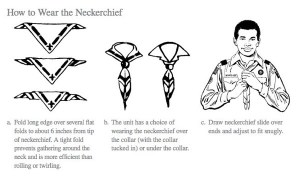
The BSA’s Insignia Guide says this about the size and shape of the neckerchief, “Official neckerchiefs are triangular in shape.” There is a more info about how to wear it, who chooses the neckerchief (the troop), who approves special neckerchiefs (the council), and so on. It does say that special neckerchiefs are “the same size as official ones”. Oddly, they don’t say what size that is.

How to wear neckerchief

So I researched it. One reason to have a bigger neckerchief is so it can be used as a triangular bandage, so I also checked the common sizes for those, including the ANSI-standard size.

Continue reading

Hilbert, Bochner, and Studying for Amateur Extra

I’ve been studying for the Amateur Extra license exam, the highest level of FCC license for amateur radio. Right now, I’m reading about Hilbert transforms because they are mentioned in a question (E7C09 from the Extra question pool, if you care). I’m pretty sure that I learned Hilbert transforms thirty years ago in my Signal Theory class.

Continue reading

KTRU is Dead

I just received an e-mail from Rice President David Leebron explaining the sale of KTRU’s spectrum, transmitter, and antenna to the University of Houston. This will give KUHF two powerful transmitters for their NPR and classical music snoozefest, replacing the eclectic voice of Rice. Leebron pointed out that KTRU’s Arbitron numbers were invisible, that the $9.5 million from the sale would help fund the new East Servery (kitchen), and that the station would continue on the Internet at ktru.org.

I was a KTRU DJ from 1979 to 1981 and I helped install the new antenna on top of Sid Rich that finally got the signal beyond the hedges.

I sent him this reply.

Continue reading

Pyramid Tents at Philmont

I brought my Mountain Laurel Designs Speedmid to Philmont and my son brought his brand-new Black Diamond Betamid. The Betamid is interesting because it is decently light and probably the least expensive high-quality shelter you can find. A Scout is Thrifty.

We didn’t get a lot of rain, but we did get one good nighttime thunderstorm. Everybody stayed nice and dry.

Here is Mike (on the right) and his Betamid at Apache Springs:

_MG_1149

Continue reading

Commander’s Kitchen: Chicken Étouffée

The Commander’s Kitchen cookbook has a section on “krewe meals”, the food they cook for the staff twice a day. I may never make Quail with Crawfish Stuffing, but the krewe meals are home cooking.

I made their Chicken Étouffée this week. Straightforward, though browning the roux after you make the cajun mirepoix required some bold high heat cooking. Instead of “hot sauce to taste” (love that), I used a cayenne pepper that I’d frozen from last year’s organic veggie box. I might back off on the sage next time — two teaspoons dried sage is a lot for one chicken. Still, pretty danged good and the family was happy with it.

They do a clever thing with rice. In addition to some salt and butter (one tablespoon for one cup of rice!), they add two bay leaves. It adds a really nice aroma, more delicate than I expected.

MLD Speedmid Tent – Less is More

My big Christmas present was a lightly-used Speedmid tent from Mountain Laurel Designs. It sleeps two people in comfort and weighs under a pound and a half with tent stakes and stuff sack. It uses a single trekking pole as a center pole. There is no floor, so I bring a big sheet of Tyvek (12 oz.) or a single person polycryo groundsheet from Gossamer Gear (2 oz.).

I use a breathable bivy (Ptarmigan from Titanium Goat) in case of condensation or blown rain. I also like to tuck my head inside the bivy when the breeze picks up. The bivy is essential for tarp camping, but I’m not sure it is worth carrying for use inside the Speedmid, even though it is only 7.5 oz.

Here is the tent set up at Eagle’s Aerie campsite in the Sunol Wilderness. It is set up very low to the ground, because we expected wind and rain. In less threatening weather, the tent can be pitched with the edges higher for more ventilation and more room inside.

IMG_0526_crop

Continue reading