Whip Antenna Support for KX3

A Nite Ize Gear Tie seems to do a decent job of supporting the MFJ-1820T 20 m whip antenna on my Elecraft KX3. I first tried forming it into a bipod, but then got the idea of attaching it to the SideKX endplates. Success!
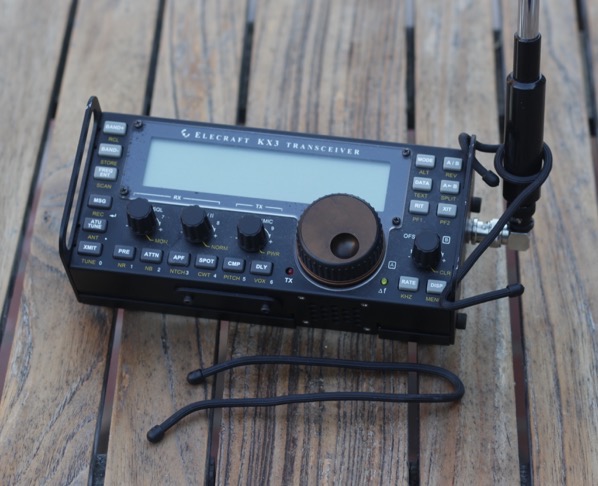
KX3 gear tie 1

I’m using a Nite Ize Gear Tie 12 inch because I had one. The fatter one didn’t really fit through the handles.

The whole setup is pretty cheap. $25 for the antenna and $6 for two gear ties. It isn’t as efficient as a 20 m dipole, but it is kind of cute.

23cm PC Board Yagi

I wanted a bit more “oomph” from my 1W 1.2 GHz HT, so I purchased a PC board Yagi to get another 6 dB.

I have a Yaesu FT-911 1.2 GHz HT. It is a 1990’s rig gifted me by the wife of a Silent Key at my work. It is a sweet handheld, but with limited power.

WA5VJB makes a variety of PC board antennas. The 1.2 GHz 3-element Yagi is $6, which was hard to resist. He also makes other nice microwave antennas: log-periodics, patch arrays, wheels, vivaldis, etc.

Continue reading

Speakers for my Elecraft KX3

Want speakers for your rig? No need to wait. For about the cost of a tank of gas, you could be sitting back and enjoying armchair copy.

The internal speaker in my KX3 is good but not great, plus the rig has stereo effects which you can’t hear through the single speaker. The headphone jack provides 100 mW per channel, which is not enough to drive speakers to a reasonable listening level.

This is my under $35 setup for an external audio amp and stereo speakers. Of course it would work for any other rig.

Continue reading

SOTA at Philmont

There are ten summits inside Philmont Scout Ranch that are listed in the Summits on the Air (SOTA) amateur radio program. There are another three summits within the Valle Vidal region to the north of the ranch. Only six of these thirteen peaks have been activated by SOTA operators.

SOTA is an award scheme for radio amateurs that encourages portable operation in mountainous areas. I think it is a great match for Scouting, combining the outdoors, technology, and world fellowship. Grab a radio, hike to the top of a mountain, and talk to people.

Continue reading

Short Podcasts for the Beginning Ham

Since 2011, Onno (VK6FLAB) has been producing weekly podcasts for beginning Australian amateur radio operators. The podcasts are short, from one to three minutes long. I’m no longer a beginner, but I really enjoy the podcasts. They are full of curiosity, advice, and encouragement. They make me want to get on the air.

The first series of podcasts, What use is an F-call? ran from 2011 through June 2015. These were about operating with with the Australian Foundation Licence, the entry-level license there.

The second series, Foundations of Amateur Radio, is still for Foundation Licence holders, but has a name that makes a bit more sense to non-Australian hams.

Each podcast has a text transcription, which helps with handicapped accessibility. Those are available on the website and I can see them in my iOS Podcasts app.

Continue reading

Building a Dummy Load

If you plan to transmit on your radio, you need a way to test your transmitter without radiating a signal. You do that by transmitting into a “dummy load”. I had a 20 Watt dummy load, but I needed one to handle 100 Watts, so I built a $40 kit in June. This was the first serious soldering I had done in years, maybe decades.

I built the Oak Hills Research RFL-100 kit. A pre-built 100 W dummy load is usually $150-200. This kit is $40.

Continue reading

International Radio Scouting Badges

Radio Scouting is an international activity, and the World Organization of the Scout Movement (WOSM) has patches and pins for it. I love the classic design, and I also love the price, with the current exchange rate.

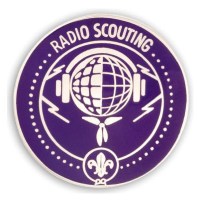
The WOSM Radio Scouting emblem looks a lot like the World Scout Crest, but with a radio twist. It has the same purple background, but instead of the circling rope, it has dots, like Morse Code. The fleur-de-lis is at the bottom, and the center is a globe with headphones, a neckerchief, and some lightning bolt lines. It sounds complicated, but it says “Scouts on the radio around the world” without using words.

Radio Scouting patch Radio scouting pin

Right now (late 2016), the cloth badge (patch) is $1.29 (£1.04) and the metal badge (pin) is $1.81 (£1.46). You can work out the shipping cost yourself, but I think it is worth it to wear the world-wide symbol of Radio Scouting.

Send your name in Morse code!

This sounds like great fun for Boy Scouts or any youth-oriented radio activity. Here is the description from Dan Romanchik’s blog (kb6nu.com) about teaching Morse at the Ann Arbor Mini Maker Faire.

As usual, I had my collection of keys and was teaching kids (and some adults) how to send their names in Morse Code. I have a chart of the characters (see right) that I tape to the table next to the key, and when someone approaches the table, I ask if they’d like to learn to send their name in Morse Code, and if they say yes, I ask them to tell me the first letter in their name.

After they tell me, I show them the character on the chart and then show them how to send it. Once they’ve successfully done that, I tell them to look up the rest of the letters and then send them as well. If they successfully do this, I thrust out my hand and say, “Nice to meet you, Joe (or whatever name they just sent me).” The look on some faces is priceless.

Continue reading

History of Morse Code in the Boy Scouts

Morse code has been in and out of the Boy Scout requirements for over a hundred years. During that time, Morse has changed from a career skill to a rewarding hobby, from a vocation to an avocation. Also during that time, radio has grown to include voice communications, data communications, and broadcast.

Morse interpreter strip

I’ve gathered all the requirements I could find: rank, merit badge, or skill award. Morse was a requirement for First Class for 61 years, 1911 to 1972. It returned as an option from 1979 to 1990 during the skill award period of BSA advancement.

Continue reading

Radio Scouting: Hike Safely

The Hiker Responsibility Code says “Be prepared..to stay together” on the trail. BSA rules require adequate supervision. But how do we stay together and be safe on a troop hike with thirty or forty Scouts? We can hike in independent groups, each with two adults and a crew first aid kit. Or, we can stay in touch with radio communications.

Crew 27 in our area has a scheme for coordination on a hike. Each independent group has a radio. The last group, “sweep”, has adults and a radio. All groups check in every 15 minutes. If a group cannot communicate with sweep, they halt and wait for the groups behind them to get closer. A hike group can relay messages to and from a forward group.

T 14 at Henry Coe 2006 crop 1

Continue reading

Radio Scouting: Emergency Preparedness Merit Badge (and Beyond)

E. Prep. merit badge requires the Scout to take part in an emergency mobilization and make a plan for emergency service. Why not let your local amateur radio ARES/RACES group help out?

Amateur radio operators work with their local communities to prepare for emergencies. They do this with drills, frequent radio practice, and public service (which is also mobilization practice). Many groups have a radio communications net every week. Scouts can also work with CERT (Community Emergency Response Team) and other emergency volunteers.

Let’s look at the three parts of requirement 8 for the Emergency Preparedness merit badge.

Continue reading

Radio Scouting: Patrol Camping

Patrols should camp out of earshot from each other and the adult leaders. But how do we provide adequate adult supervision in that situation? With radio communications, of course!

An ideal troop campout has patrols camping separately, probably 100 feet to 100 yards apart from each other. The SPL and ASPL(s) camp separately. The adults should also be at the same distance. But in that configuration, how do the adults provide “qualified supervision” as required in the Sweet Sixteen of BSA Safety? And how does the youth chain of command from Senior Patrol Leader (SPL) to Patrol Leader (PL) work?

Continue reading

Transmit Equalization and Compression with the Elecraft KX3

This is long, but it combines multiple recommendations from the KX3 and Elecraft mailing lists into a single procedure.

First, update to the latest KX3 firmware. There was a new compression algorithm in 1.50 and fixes in 1.61 and 2.30.

Then, get your KX3 manual. If you can’t find a paper copy, download the latest KX3 Owner’s Manual. You will be looking up a few menu settings.

The audio adjustments are done in separate steps:

  1. Transmit audio equalization (TX EQ).
  2. Microphone bias config.
  3. Microphone gain.
  4. Compression level.

Continue reading

Better Yamaha CM500 Audio with PTT on Elecraft KX3

With a $6 cable, you can get cleaner microphone audio from your CM500 headset, or any other electret mic or headset, plus add a jack for a PTT switch.

The Yamaha CM500 is a very popular headset for amateur radio use. It is rugged, effective, and affordable — $60 at B&H Photo and $55 at Amazon. B&H has a much more accurate description of the product.

Continue reading