Don’t Know Trees? Try Leafsnap

Leafsnap is an iPhone tree identification app. It works for trees when you have internet service, but you might want to carry some paper backup. Luckily, it’s free.

The Leafsnap iPhone app recognizes tree leaves from phone photos. It does a good job, but there are some limitations. You need to shoot a leaf against a white background, and it has to be a tree leaf. I tried it on some shrubs (Western Azalea and Fuchsia-Flowered Gooseberry), but they were not recognized. Yes, we have both of those in our back yard. Lovely plants.

Continue reading

BSA Incident Reporting

I’m excited about the incident reporting that the BSA requires now, but there may be a few kinks to work out.

How are they going to handle the volume with paper reporting? Using the back of a virtual envelope, we have 40,000 troops and five reports/year from each one. That is 200,000 reports. They’ll be lucky to get a few thousand this year, but on-line reporting is a must.

Any “first aid” is a Marginal incident, which must be reported within five days. That means a report for every blister. With about 900,000 Scouts and Venturers, 100% reporting could mean a million reports per year.

Continue reading

BSA Fieldbook Fumbles the Ten Essentials

The essence of the Ten Essentials is easy—carry these ten things to help you not die on the mountain. It is a part of risk management and planning. The new BSA Fieldbook gets this upside down, making it all about gear. Also, the Fieldbook sticks with the 1930’s list, instead of moving to the 2003 “systems” Ten Essentials. For more details, see the current edition of Mountaineering: The Freedom of the Hills.

Continue reading

New Checklists and Reporting Requirements in Guide to Safe Scouting

The quarterly update of the Guide to Safe Scouting includes two new checklists in the appendix.

The Campout Safety Checklist (PDF) is two pages long with 35 items, and a big improvement in BSA risk management. Some of the checklist items:

  • Have weather conditions been checked and communicated?
  • Has an adult been assigned to help Scouts with taking meds?
  • Is a mechanism in place for contacting a camp ranger or camp office (e.g., walkie-talkie, mobile phone, etc.)?
  • Has the location of the nearest hospital/ER been identified and announced to all adults?
  • Is the unit first-aid kit in a conspicuous location and readily available?
  • Have any incidents been recorded and reported, if necessary, to BSA professionals?
  • Have the adult and youth leaders captured any lessons learned from the campout?

There is a similar Event Safety Checklist (PDF) for non-camping activities.

Continue reading

Couples Backpack to Mission Peak

There is a little-known campsite at Mission Peak, but it is one of my favorites. The views are wonderful and it is a perfect base camp for catching a sunset from the peak, or a sunrise, if that is your persuasion.

My wife and I restarted our backpacking with an overnight to this spot, accompanied by another couple. This was my first non-Scout backpacking in years, and it was lovely.

Mission Peak is a very popular hike—we were amazed at the number of people up there at sunset. The rest of them had to hike all the way out in the dark. We strolled back to our campsite. This photo is only a sample, we counted over fifty people. It was a party.

_MG_5061

Continue reading

Trying Lightweight Hiking Socks

I tried lightweight socks on my most recent backpacking trip and really liked them. I’ve been wearing thick wool socks for backpacking since the 1970’s. I stopped using liner socks a decade or two ago, but I had never tried lighter main socks like the thru-hikers wear now.

The forecast was for continuous soaking rain, 48º temperatures, some steep trails, and a fair amount of idle time waiting for the next participant patrol to come to my area. That’s a good sock test, with a nice chance to have cold, wet feet, plus blisters. But less sock means less wet sock, right? And if I get a blister on a two-night outing, I can deal with that.

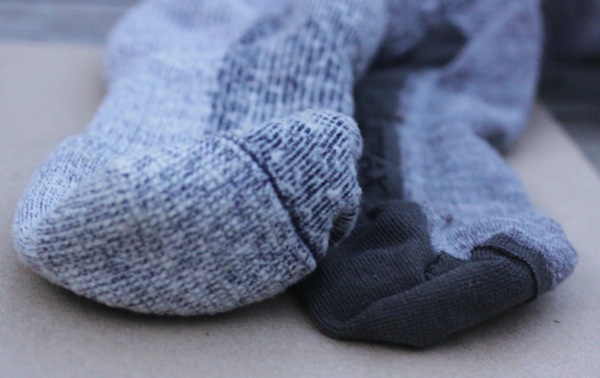
I grabbed some light socks at REI, Wigwam Merino Airlite Pro. They are roughly one third each of merino wool, stretch nylon, and polyester, plus a smudge of cotton. There is no cushioning, just a nice smooth fit.

Here they are with my previous socks, SmartWool Trekking, 77% merino wool and probably one of the heavier socks you can find.

IMG 6946 crop

Continue reading

Cooking Merit Badge: Trail Cooking Fail

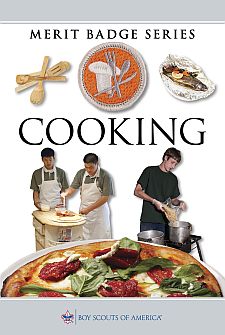
Cooking coverI had high hopes for the backpacking recipes in the 2014 Cooking merit badge pamphlet, but I’m deeply dissapointed. The previous edition listed a single entree with no vegetables and two dutch oven desserts. The new edition has two entrees, but neither can work as trail meals. The first recipe uses raw meat, forbidden in the requirements. The second is mostly heavy canned ingredients. Both have excess that you either toss (violating LNT) or pack out.

This pamphlet is an obstacle to a Scout working on Cooking merit badge. These recipes fail the requirements and direct the Scout towards a style of cooking which doesn’t work for backpacking. These recipes are not “quick, light, and easily stored” (page 47).

Continue reading

Trail Cooking — Homemade Backpacking Meals

Prepackaged backpacking food is often blah and expensive. If you’ve thought “I could do better than this”, start with this book, Trail Cooking: Trail Food Made Gourmet. This is the brand-new cookbook from Sarah Kirkconnell, who writes at trailcooking.com.

The meals I’ve made from this book and it’s predecessor, Freezer Bag Cooking, are easy to make, cost half as much as pre-made backpacking meals, and are bigger portions, that is, enough food.

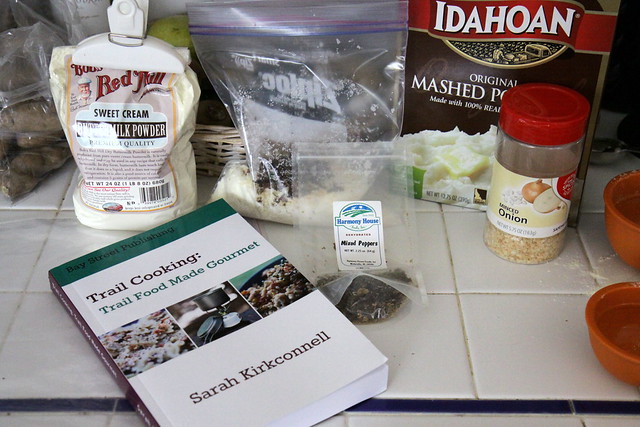
I made “Cheese Steak Mashers” (page 171) for a weekend backpack that was forecast to be wet and cold (it was). Here is the ready-to-pack meal (the bag in the center) along with the ingredients.

IMG_6906_leveled

Continue reading

Streamlight Nano Review

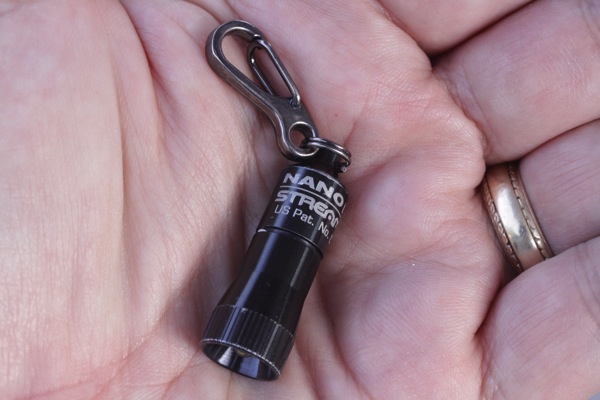
I bought my Streamlight Nano flashlight on a whim (Amazon link). My other Streamlight flashlights have been great (except for the Stylus, kinda flaky). One penlight went through the washer with no ill effects, and my big “cop flashlight” continues to be impressive.

The Streamlight Nano is $7, 10 grams, and more weather resistant you’d expect in an ultralight flashlight. Plus, it has a really nice clip, which is good, because you’d lose it without that.

IMG 6912

Continue reading

Wet High Adventure Training at Cutter Scout Reservation

This was my first time staffing our council’s High Adventure Training (HAT) course. We recommend this course for any adult leading a backpacking trip of more than a few miles or more than a weekend. With three long weeknight sessions and a two night backpacking outing, we go into a lot more detail on risk management, navigation, weather, lightweight gear, and so on.

Our course director was hoping for rain, not because he enjoys it, but because it puts the participant’s skills under additional stress, allowing them to learn more. Some lessons are straightforward, like learning that your jacket leaks. Others are more subtle, like using a map in the rain or cooking and eating dinner in the rain.

Rain started after bedtime Friday and continued until early Sunday morning. It was 48º straight through, ideal hypothermia weather if we’d had wind. The rain let up a few times in the afternoon, I even took off my rain shell for a bit, but it was mostly a rainy, cold weekend. If you haven’t been in a redwood forest, the tree drip continues long after the rain has stopped. Half of the precipitation in a redwood forest is tree drip. You can’t tell whether it has stopped raining until you step into the open. We camped under trees, of course.

Luckily, it was dry and sunny at home, so I could dry out my gear.

IMG_6910

Continue reading

Veggie Exotic Couscous (Freezer Bag Cooking)

This is a surprisingly tasty meal. I always use this in my cooking demos and people are always a bit suspicious until they taste it. Then they want seconds. For a purely vegetarian (even vegan) dish, use vegetable bouillon instead of chicken bouillon.

On a whim, I threw in dried apricots and I was really happy with that addition. If you can get them, use local Blenheim apricots rather than the cheap stuff. Once you’ve had Blenheims, the Turkish apricots taste like cardboard. Trust me.

Continue reading

Manzanita Ridge – Short Backpack Outings for Scouts

What backpacking outings make a young Scout really want to get back on the trail? I’m posting some of my favorites from my area, the southern part of the San Francisco Bay area. These work as anyone’s first backpacking trip, but emphasize group camping areas and short, fun trips.

Manzanita Ridge at Henry Coe State Park is a great first backpacking trip. Also check out the pages for The Pine Ridge Association, the volunteers who support Henry Coe SP.

  • 2.5-3 miles each way (depending on which campsite you choose)
  • gentle elevation changes

Manzanita Point has ten group camps stretched out along the end of the road. They all have their advantages, but don’t underestimate the sites at the end of the road (8, 9, and 10).

Continue reading

Castle Rock State Park – Short Backpack Outings for Scouts

What backpacking outings make a young Scout want to keep doing this? I’m posting some of my favorites from my area, the southern part of the San Francisco Bay area. These work as anyone’s first backpacking trip, but emphasize group camping areas and short, fun trips.

Castle Rock State Park

  • 2.8 miles between the trailhead and camp
  • -1200 feet to campsite, +1200 feet back

Castle Rock trail camp has 20 sites in two separated areas. This is an ideal place for patrols to camp separately, with the adults in another campsite. The campsites have water. Firewood is available for $7 per bundle at the campsite (bring exact change). Check the fire hazard warnings before going, because campfires are only allowed in the rainy season.

Continue reading

Two new Scout-like groups

It is a busy week for alternatives to the Boy Scouts of America. On Tuesday, OnMyHonor.net announced that they sponsored a meeting to organize “a new scouting-like organization for young men”. In today’s San Francisco Chronicle, I read about DIY.org a maker-inspired group, Online DIY startup lets kids make good (sorry about the paywall). Odd that both groups actually use their URL as the group name. I’m waiting for that to go out of fashion.

Continue reading