
I tested the FlipFuel fuel transfer device and it works well to consolidate partly full fuel canisters. It left about 6% of the original contents un-transferred (13-17 g), roughly enough to boil 3-4 cups of water. I’m OK with that performance. I started with six canisters ranging from 22% to 55% full and ended up with three canisters that were 74% to 81% full and three punctured, empty canisters in the recycling bin.
I weighed all the canisters, decided which ones would be the recipients (the most full canisters) and which ones would be matched as donors (chosen to match the remaining capacity in each recipient canister).
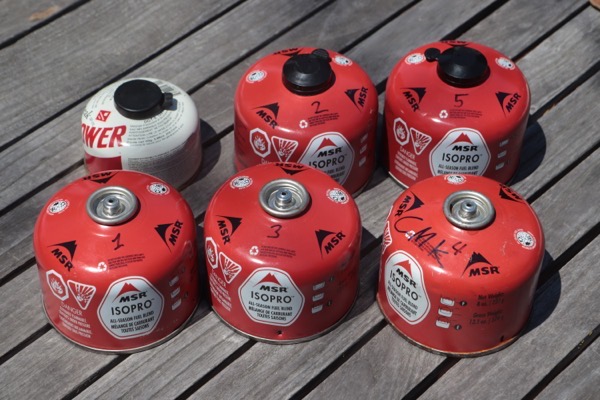
Canisters 1, 3, and 4 were donors. Canisters 2, 5, and 6 were recipients. Number 6 is a 110 g (4 ounces) SnowPeak canister, the others are all 227 g (8 ounce) MSR IsoPro canisters. The canisters take Sharpie markings really well.
The empty weights are after puncturing the canisters to vent the remaining fuel.
| Start | Xfer 1 | Xfer 2 | Xfer 3 | Empty | Start % | End % | Role | |
|---|---|---|---|---|---|---|---|---|
| 1 gross | 207 | 164 | 148 | 26% | 7% | donor for #6 | ||
| 1 fuel | 60 | 17 | ||||||
| 2 gross | 271 | 315 | 55% | 74% | recipient | |||
| 2 fuel | 124 | 168 | ||||||
| 3 gross | 243 | 163 | 149 | 42% | 7% | donor for #5 | ||
| 3 fuel | 96 | 16 | ||||||
| 4 gross | 197 | 160 | 147 | 22% | 6% | donor for #2 | ||
| 4 fuel | 50 | 13 | ||||||
| 5 gross | 252 | 332 | 46% | 81% | recipient | |||
| 5 fuel | 105 | 185 | ||||||
| 6 gross | 140 | 181 | 36% | 74% | recipient | |||
| 6 fuel | 40 | 81 |
For canister 1, it transferred 72% of the fuel, transferring 47 g, leaving 17 g. For canister 3, it transferred 83% of the fuel, transferring 80 g, leaving 16 g. For canister 4, it transferred 74% of the fuel, transferring 50 g, leaving 13 g.
The fuel vented when I punctured the canisters was 6-7% of the original full canister.
Before transferring, you need to chill the recipient canister and heat the donor canister. You could probably repeat that process to get a few more grams of fuel transferred.
Here are the recipient canisters chilling in our freezer.
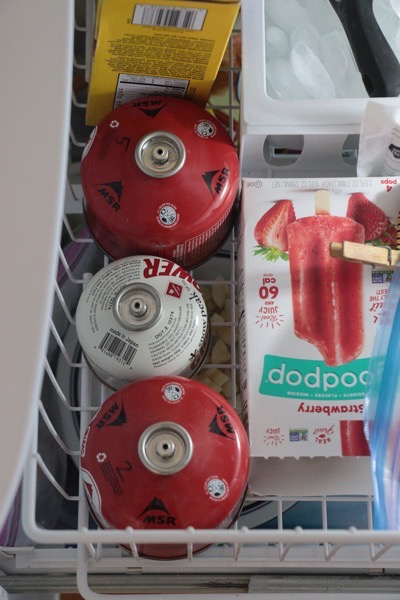
FlipFuel says to heat the donor canisters by putting them in the sun, but that seemed like it would be slow and not repeatable. Instead, I used a hot water bath in our sink. Home hot water is typically around 140º, which seemed like a high but safe level of heat.
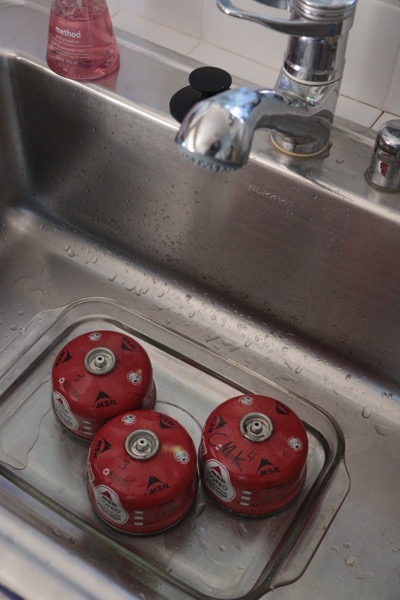
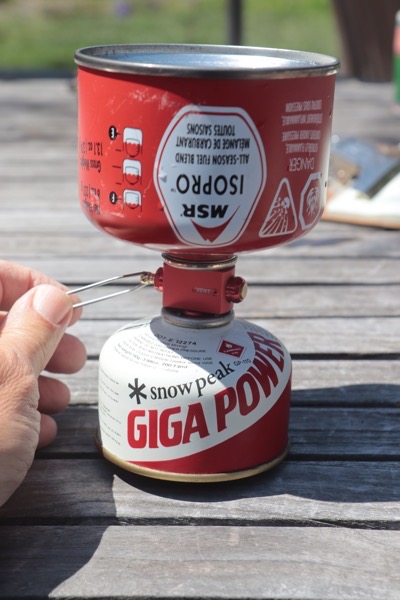
Then I pulled pairs of canisters out for transfer. Here is canister 1 transferring to canister 6.
And here is the full set of canisters. Look closely and you can see the puncture near the base of canister 3. For this many, I would allow about an hour, including the time to chill or heat the various canisters. A scale will be very helpful in planning donor and recipient canisters.
Hikin’ Jim estimates that it takes about 8 g of canister fuel to boil 500 ml (2 cups) of water. So the vented fuel in each canister was enough to boil 3-4 cups of water. That is significant, but not enough to carry on a backpacking trip. See his post on Calculating the Fuel Needed for a Trip for details and fuel planning help.
 Most Casual Observer
This method also works with mustard containers.
LikeLike